
Pathway to protective plants - a hidden vocabulary
Perhaps it was inevitable that I would wander back to the botanical as I looked for direction in my thinking on islands, protection, and exhibition ideas, but it was a slow winding path that led me to the whys and wherefores.
Spending time on the island of Inis Oírr, discovering the tiny plants growing in their own ecosystems within the grykes of the limestone outcrops, gave me pause to consider these tenacious plants, to look closer, and then to take more notice of the plants all over the island.
Plants growing in amongst the stone of Inis Oírr
In this looking, I meandered through a veil of knowledge into a land where the plants that grew in the crevices, as well as along the roadsides and shorelines, at doorways and graveyards, revealed layer upon layer of other meaning. It was like looking at a specimen through a microscope and discovering an unseen landscape of cells.
I knew of the myriad medicinal qualities of plants, but what came as a surprise to me was the breadth of their protective benefits within folk tradition. Protection from illness, storm, drowning, sorcery, witchcraft, faery mischief, lightning, evil forces and accidents while travelling — beliefs imbued in them for centuries within the Celtic tradition — a hidden vocabulary revealed.
Here was a language I felt I could connect with. On Lunawanna-alonnah / Bruny Island, Tasmania I am a newcomer, without roots in either its Aboriginal history or its settler knowledge systems — neither is mine to claim. But these plants are different. Having grown up in England and spent time in Ireland, names like Juniper, Honeysuckle, Elderflower, St. John's Wort, Yarrow and Speedwell feel like kin — family you may never have met but recognise instantly, a relationship grown through centuries of shared living in the same landscape.
Harebell, Herb Robert, Bloody Cranesbill, Hawthorn
I had never paid heed to the Rowan or Bay growing at the front door, the Elder near the back door, the Yew or the Hawthorn in the graveyards and the Oak at the boundary; but as I learned more it was apparent that centuries of myth, habit and folklore had made these planting practices a part of life.
It is intriguing the ways in which plants were utilised for protection in Celtic folk tradition — pouches of dried flowers would be carried in the pocket, or worn around the neck or tucked into clothing; they could be woven or braided together into small wreaths, crosses or knots, posies might be hung in barns or the home, infusions of flowers may be made, the liquid then used to bless homes or livestock.
These plants carry protective histories as threshold guardians, they are grown and carried and placed at the liminal - on windowsills at the turning of the seasons, at doorways between wild and sanctuary, at crossroads, bridges and shores - thin places where the veil between the physical and spiritual worlds is permeable. They occupy the space between danger and safety. These liminal spaces often feel charged with a particular energy because they’re places of potential, where transformation is possible, where you’re neither fully in one world nor the other.
And now, like walking the periphery of Inis Oírr, I have followed my path circle-fashion back to islands and edges, because to me islands also inhabit this liminal space. Islands exist between land and sea — not quite one or the other — the known mainland and the unknown open ocean, between safety and vulnerability. Their power lies at their edges.
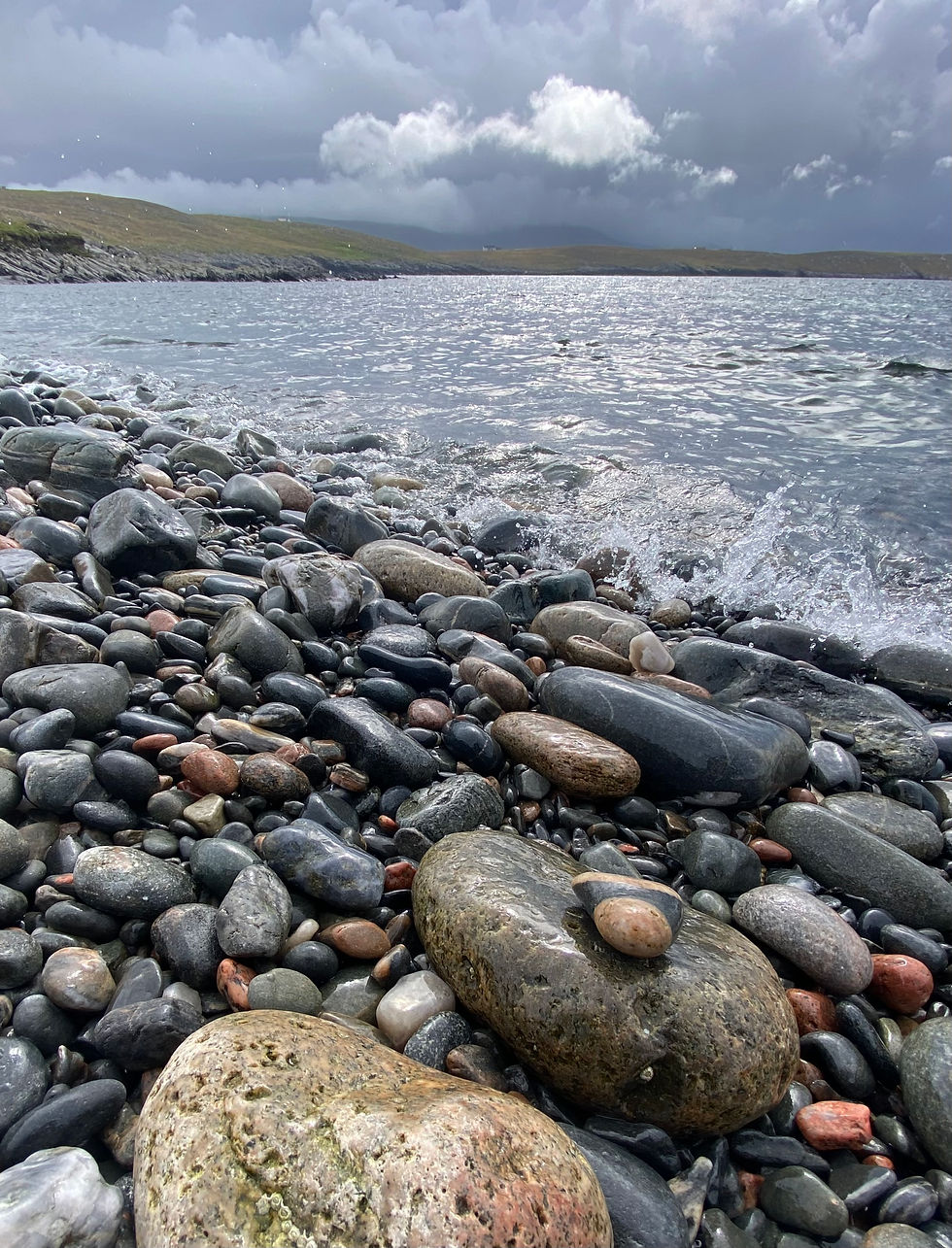
Island edges of Inis Oírr & Shetland
I came to realise that I wanted to craft my own collection of these special protective liminal plants from silver - a material that itself holds powerful protective associations. I choose fabrication over casting because this creative process requires construction, not reproduction. Fabricating these plants by hand, translating organic forms into metal through sawing, forming and soldering takes time and patience. Each stem, each leaf, each flower head is an interpretation rather than a cast reproduction and this is what matters: I am not claiming direct transfer of protective knowledge but rather building my own material vocabulary from documented traditions, looking at how protection is constructed — whether across hemispheres or across the workbench. The making process teaches me what I'm investigating. Every plant fabricated deepens my understanding of what it means to translate protective practice from one context to another.

Each plant begins as flat sheet metal, coaxed into dimension by hammer and heat. A yarrow stem is perhaps two millimetres across. A petal no wider than a fingernail. The scale demands a particular quality of attention — slow, close, deliberate. There is something fitting in this: to fabricate protection, piece by tiny piece, is to understand in my hands what I am investigating in my mind.

It is at this point along the road of thinking that these protective plants meet with my discoveries about precious pebbles, thunderbolts and sea-beans, recognising one another as kindred amulets.
For me what an amulet does at body scale, an island and its shore does at landscape scale. They offer protection from uncertainty itself. Not necessarily from a material threat but they can give a feeling of boundedness, a knowing of our edges - a psychological security even when material security is questionable.
This work I am creating is about the gap - between wanting protection and being able to authentically claim protective knowledge, between the security an island promises and the vulnerability of living on one, between the making of an amulet and believing it works.
I know, and the work knows, that protection is impossible to guarantee - islands erode, boundaries fail, salt corrodes silver.
But perhaps the act of constructing a sense of safety — whether by crafting and carrying an amulet or planting a Bay tree — is how we hold our edges.

Comments