
A map drawn from longing
Updated: Jun 5
I didn’t know, when I set sail to the North Atlantic islands, what I was looking for. I had no grand thesis, only a large hand-bound seablue journal of thoughts, and a map drawn from longing.
… and a kind of knowing — the same knowing Valentia had first given me as a child, a knowing that led me to be living on another island on the opposite side of the world — a knowing that islands held something special that I needed to understand. It is only in retrospect that I can see what it was: the language and expression of protection. How people, over centuries, have built a vocabulary of safety around themselves in stone and plant and found object. How they have made the intangible manifest.
So I went. And in each place, that language revealed itself.
Shetland was first. Sally Huband's intriguing book Sea Bean had already set me looking differently at shorelines before I arrived — I was primed to peer closer, to notice what the tide brought in and left behind. But it was in the Lerwick Museum, that I first encountered sea beans: seeds and fruits of plants native to Africa, Central America and the Caribbean, that had been carried down rivers to the ocean, drifted on currents across thousands of miles of open Atlantic, to wash up on a shore at the very edge of Europe. To find one is a rare thing. And rarity, in folk tradition, can mean power.
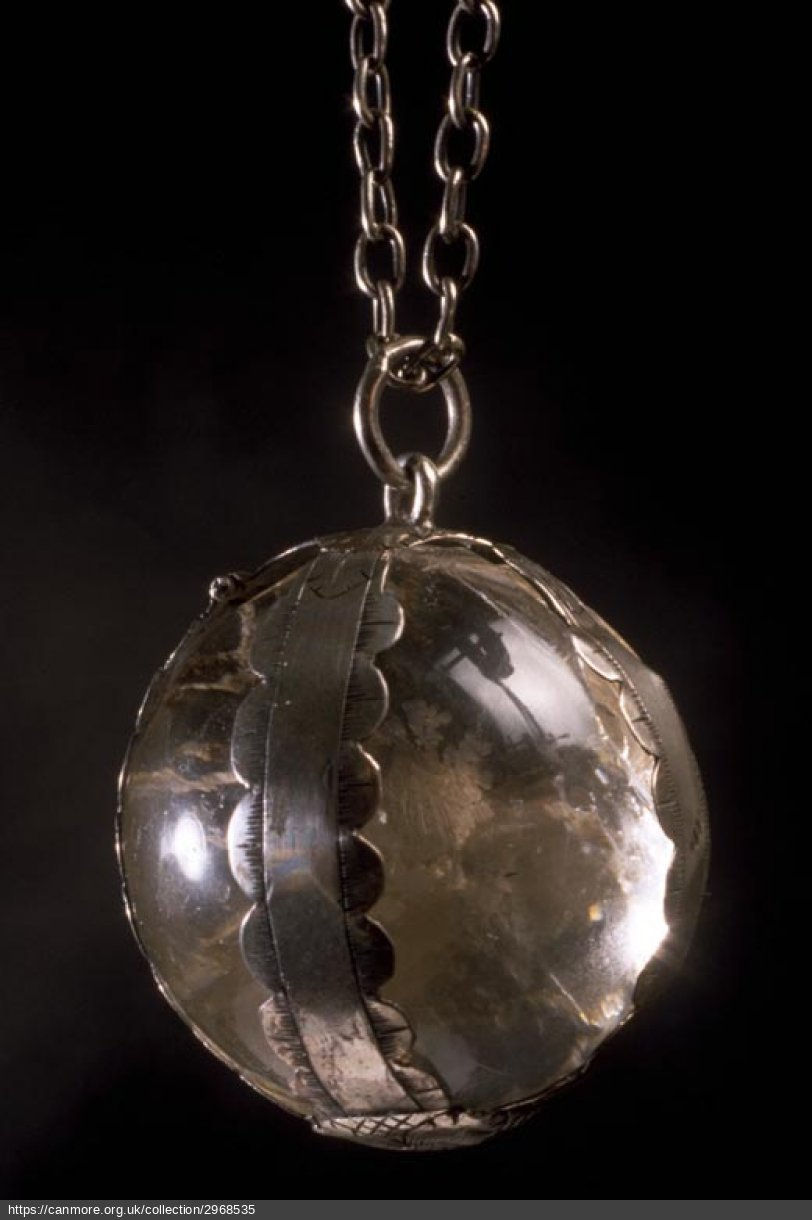
These sea beans were pressed into the hands of women in childbirth for the safe delivery of the child. They were carried by fishermen as protection against drowning. Some were set in silver, banded and hung on chains, made wearable — made precious. A seed from the other side of the world, enclosed in metal, held against the body. Warmed by beating heart, faith and hope.

In that same museum I found thunderstones: Neolithic axeheads, finely formed, smoothly polished, richly tactile — and then lost. Fallen in fields, buried under centuries of earth and forgetting, until they surfaced again. When they did, people believed they had plummeted from the sky during storms. Heaven-made, not hand-made. To keep one in the house was to keep lightning out. The journey from ancient tool to fallen sky-object to household protector speaks to something I find endlessly compelling: how objects accrue meaning across time and culture.

Lewis, in the Outer Hebrides, was a land of charmstones for me — Lewisian gneiss and the ravaging wild ocean creates shores of tide-tumbled and wave-rumbled smooth pebbles of myriad colour and pattern.
My own found charmstones in the Outher Hebrides
Traditionally, smooth quartz pebbles, naturally holed stones, stones of unusual shape or weight have been kept for generations as amulets, used for protection and folk healing. Passed hand to hand, and sometimes, like the sea bean, also embedded in a silver setting and worn close to the skin, or dunked in water, infusing the liquid with it’s special properties. Portable power.
There must be an innate pull to cradle a perfect pebble in the palm of your hand and for it to become warm from your skin. A wondrous thing to tuck it in your pocket and hold it sometimes and remember. A simple stone that carries place, memory and energy within it. There is a directness to a pebble that moves me. It is such a simple form, it asks nothing of you except to be held.
And then Inis Oírr, in the Aran Islands — that bare, beautiful, stone-upon-stone place — where I found the language of protection written not only in rock but in plants. Growing in the thin cracks between limestone flags and along salt-scoured shores: yarrow for protection against disease, honeysuckle against harmful influences, speedwell to guard travellers from accidents. Often unremarkable. Often overlooked. The kind of plant you would walk past without a second glance, unless you knew to look.
Knowing to look.
Knowing how to look.
That is what these islands gave me.
Though look as I might, I never did find a sea bean on any of these shores. However, when I returned home I discovered I already had one in my collection — most likely carried from a vine growing here in Australia, not drifted in from the far Atlantic. And it made me pause. Does that diminish it? Is a talisman still a talisman when it is severed from the culture and the place that imbued it with power? Is meaning portable? Can we create our own personal folkloric practices?
Or maybe the question is: where does power come from, and who decides? The birthing mother who clutched a sea bean in her palm as she gave birth was not asking whether it had earned its meaning. She was making a choice to trust. To invest. To say: this object, in my hands, in this moment, holds something.
And isn't that what we do with every small pebble we slip into our pocket on a shoreline walk? We see in it something — a colour, a weight, a particular smoothness — that speaks to us, that we want to cherish, that we connect with. We don't know if it will keep us safe. But we hold it anyway.
Perhaps that is protection enough.


Comments