
Why Islands?
Updated: May 20
To begin at the beginning (thankyou Dylan Thomas) ....
On the wild south west coast of Ireland, scalloped into the sea-bitten wind-whipped crumpled coastal edge lies Valentia Island; a place that sailed into my childhood and has forever anchored in me a deep love of islands.
Over the last decade I’ve taken a bit of a voyage, a peregrination of sorts — emotionally, psychologically and physically — to try to understand why islands are so important to me.
How my first island, Valentia, ended up in my life and why I feel it impacted me so profoundly. Why I am now living on another island at the opposite end of the earth, and how this all shiplaps together to create a vessel in which to build my upcoming exhibition in June 2027.
I grew up strongly loved and gently cared for many miles away from any shore, in the bucolic Cotswolds in England. Our family was somewhat disjointed — dis-located — with my brother living with my father a hundred miles away from my sister and I who lived with our mother and then later a stepfather too. My nest of sanctuary and security was with my mother. Time with my father, for a weekend a month and small holidays now and again, was unfamiliar and trepidatious but also intriguing and slightly offbeat .
Growing up this way I felt like I never really knew who my father was. I know he loved me well but when you see someone rarely its hard to know the ways of them, their ways of thinking and their bounds, and where you stand in the compass of their love. How far you can push, stretch and pull at those invisible boundaries.
But he did give us one of the greatest gifts. He introduced my siblings and I to Valentia. This island, scoured and sculpted by the ferocious Atlantic winds, made sodden yet jewel-green by lashing rains, is an island so breathtakingly beautiful that, especially on its cobaltbluesky days, could split your heart open.

My father died when I was fifteen and so my siblings and I inherited the small cottage that he had bought on the island; slate roofed, turf heated, thick walled and permanently damp, but my god it was my haven. From my mid teens on I made perpetual pilgrimage to that cottage - school holidays I’d make my way there, sometimes with friends, sometimes with family; and after I completed school, on my own, my car filled to bursting with my packed up life.

I lived there a year that time, partying the summer, falling in and out of love, making mistakes, finding resilience, learning independence and seeking out my limits - all while exploring the little island and learning its edges too.
My father’s ashes were scattered at ‘the back of the island’. A landscape that even before it became emotionally vibrant with memories of him, felt so powerful, so potent and so charged I often wonder of its stories lying preserved under the surface in the peat bog.
The black heft of the monolithic rock cliffs unrelentingly pounded by the dark seas, keep the land safe. It is a place of power and wonder and the one place in the world I feel I could sink in to the earth and rot and be one and be done. This place has obviously always had this potency, people have felt it and marked it for hundreds of years; stone crosses, holy well, standing stones.
'Back of the island' - 8th century cross Peat stained stream Wild weather pounding the shore

So Valentia has meant and continues to mean many things to me; my father, his love, my floundering independence, my growing, my learning of the power that land can hold, my exploration, my heartbreak, my heartplace, my teacher, my touchstone.
And now here I am, on another small island on the edge of a continent, facing into another fierce ocean, standing steadfast against the Roaring 40’s.
Why another island? What draws me to them?
Perhaps it’s because you know where you are with an edge. You know what’s behind you and you can see what’s coming over the horizon.
And islands are certainly good for edges.
For me I believe it is the security I feel that edges provide. A safety, a knowing.
I don't know if this feeling comes as a de-facto way of understanding my father and his edges or a subconscious childhood yearning to feel secure in the island of his love, or the fact that islands mean containment and containment is a sort of compartmentalisation
an ordering and order
control
knowing
safety
security.
A boundedness.

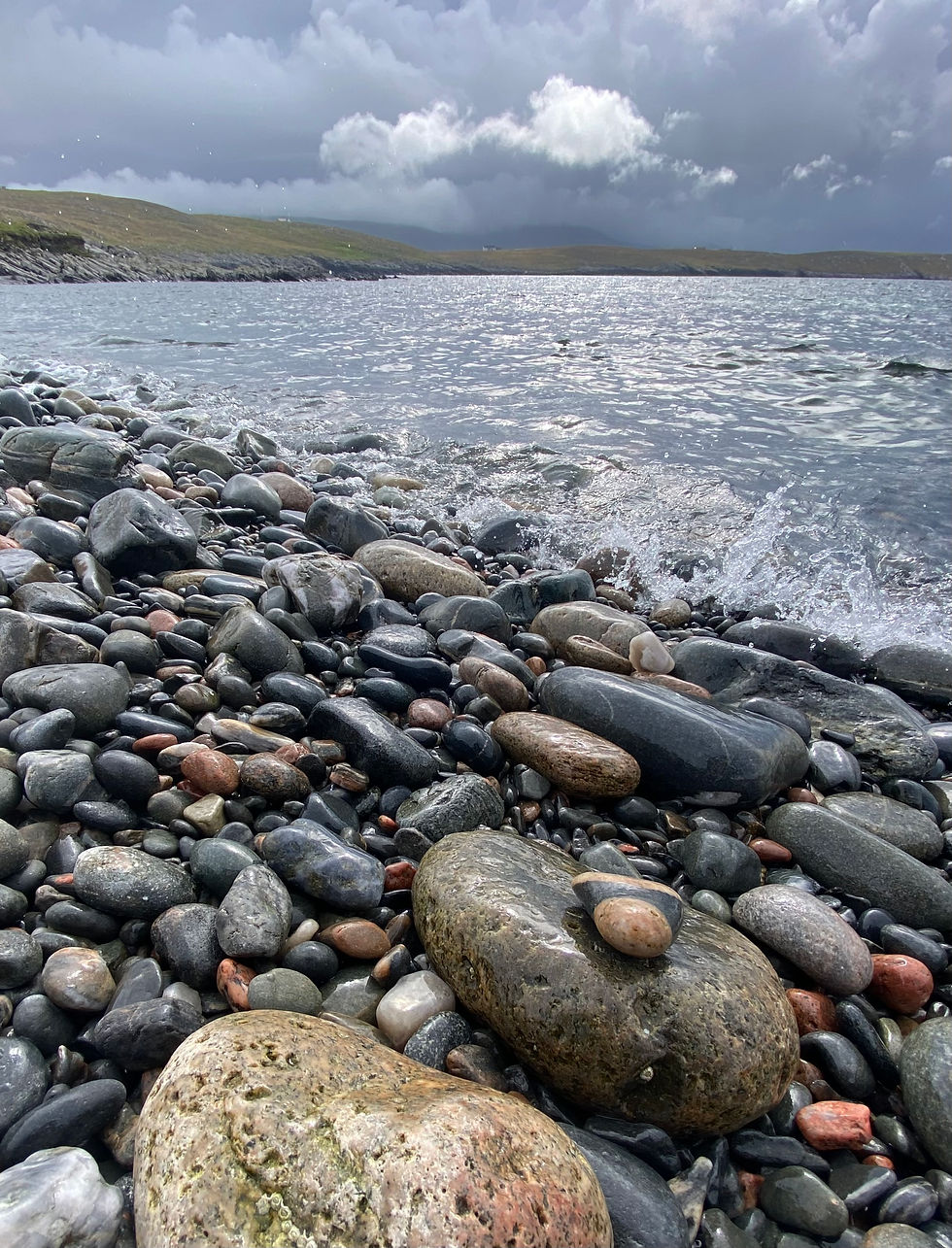
For me I am realising that loving an island is learning its edges - its shorelines of boulders, coves, coarse and fine sands, craggy outcrops, stinking seaweed beaches and other-world rockpools.
Shorelines wheel out like sentences, like stories in a book, telling me about a place, showing me itself, unspooling chapter after chapter, bay after bay.
What I also treasure about these sea edges is their life in the liminal. Sometimes water becomes land. Sometimes land becomes water. The sea shore is a boundary, but it is a shifting and relentless one, a place of potential, charged with a particular energy, where transformation is possible, where you are neither fully in one world nor another.
(We’ll keep an eye on this idea of the liminal and watch its fingers poke at other iterations of itself as we journey through my thinking for this exhibition.)
In my Celtic heritage, plants, sea and shore are not merely scenic elements — they are repositories of story, magic and ancestral knowledge. An unseen language I yearn to learn. These islands, these shorelines — their edges, their thresholds, their ancient grammar of protection — are the places where I am most at peace. And I am only now beginning to understand why.


You write beautifully Soph. Look forward to hearing more of your ponderings and personal stories - and to seeing where they take you.
A wonderful and wonderfilled start Sophie. I will delight in following as you journey. Happy that we have shared time, walking together on each of our own very very distant islands. Although I've yet to know your Tasmania. Maybe next time!